
Project JalTara
A scalable answer to India's groundwater crisis, built one acre at a time.
Transforming Impervious Earth into an Absorbent Sponge
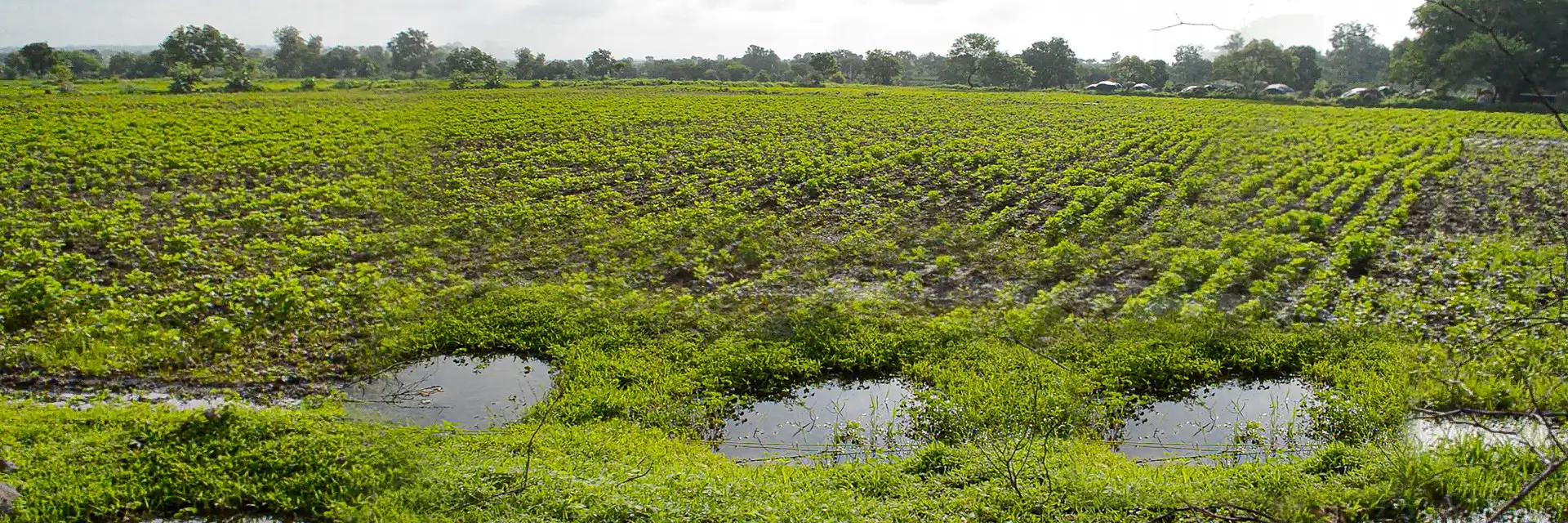
The core difficulty in India's groundwater crisis is that the topsoil in much of rural India has become dense and impervious. When monsoon rains arrive, the water cannot penetrate the surface. It runs off, floods low-lying fields, and drains away without replenishing the aquifers that farmers depend on for the rest of the year.
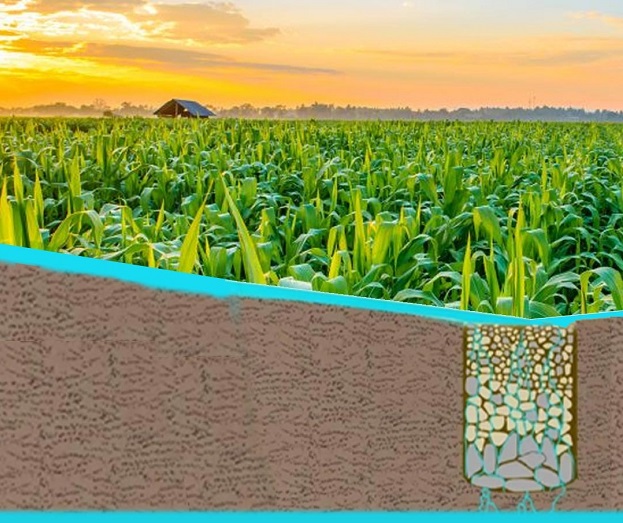
JalTara addresses this with a direct, low-cost intervention: one recharge structure per acre of farmland. Each structure is a pit, 6 feet deep and 4 feet square, dug at the lowest point of a farmer's plot. It is filled with graded layers of rocks, pebbles, and gravel that act as a natural filter. When it rains, the water flows into the pit and percolates down through the fill material, bypassing the hard topsoil and reaching the underground aquifer.
Two fruit-bearing trees are planted on either side of each structure, adding to land use and providing ecological benefits. An average village receives around 500 recharge structures.
The technique is:
Simple enough for any farmer to understand and maintain
Inexpensive to build with locally available materials
Effective after the first monsoon, with measurable increases in well water levels
Scalable to any number of villages without requiring centralised infrastructure
JalTara at a Glance
Independently Verified Results
In December 2022, GIST Impact conducted an independent stakeholder impact assessment of the JalTara Groundwater Recharge Project in Mantha Tehsil, Jalna District, Maharashtra. The assessment covered 4 pilot villages (where 1,400 recharge structures were built in summer 2021) and forecast the impact for 33 additional villages (where 17,000 structures were built in summer 2022). The assessment surveyed 40 farmers in the pilot phase and 100 farmers in the scale-up phase.
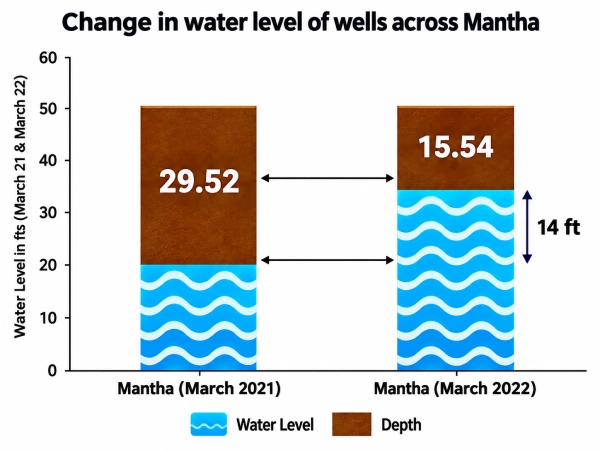
Water Table: Up 14 Feet
The average water level in wells across Mantha rose by 14 feet between March 2021 and March 2022, a 48% increase. Farmers who previously ran dry in summer now have water available year-round.
Farmer Income: More Than Doubled
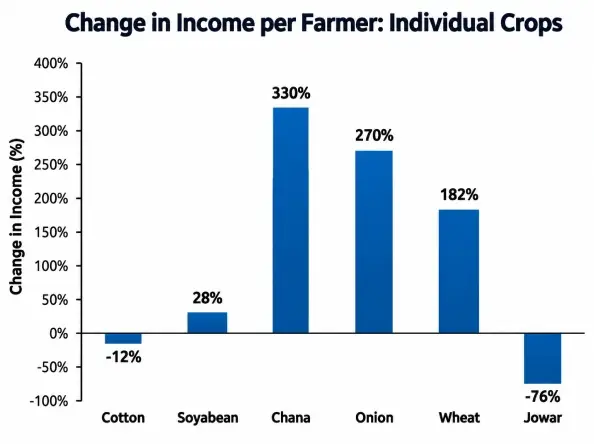
Average farmer income increased by 120%. Income from chana grew by 330%, onion by 270%, wheat by 182%, and soybean by 28%. Cotton and jowar income declined (by 12% and 76% respectively) because farmers shifted cultivation area to higher-value crops that were now viable with the improved water availability.
Crop Yield: Up 42%
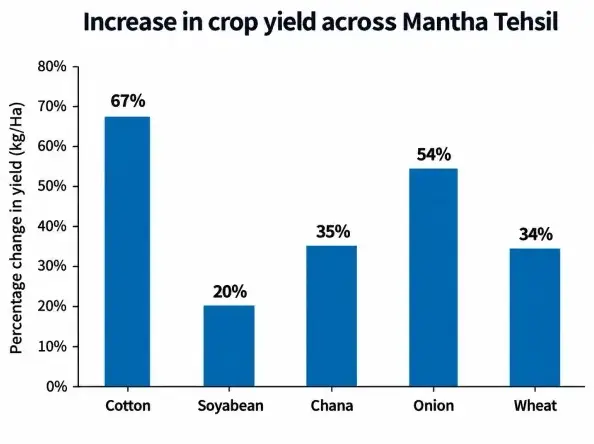
Average crop yield increased by 42% across all major crops. Cotton led with a 67% increase, followed by onion at 54%, chana at 35%, wheat at 34%, and soybean at 20%.
Waterlogging: Eliminated Entirely
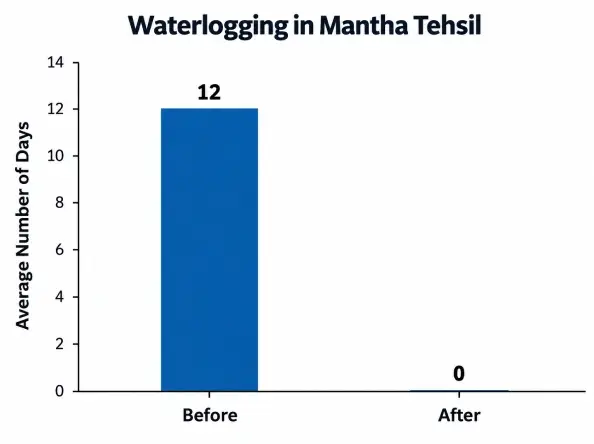
Before JalTara, farms in Mantha experienced an average of 12 days of waterlogging per monsoon season. After the recharge structures were built, waterlogging dropped to zero. The pits absorb excess surface water during heavy rains, preventing crop spoilage and removing the mud that made farms unworkable.
Employment: Up 88% in Rabi Season
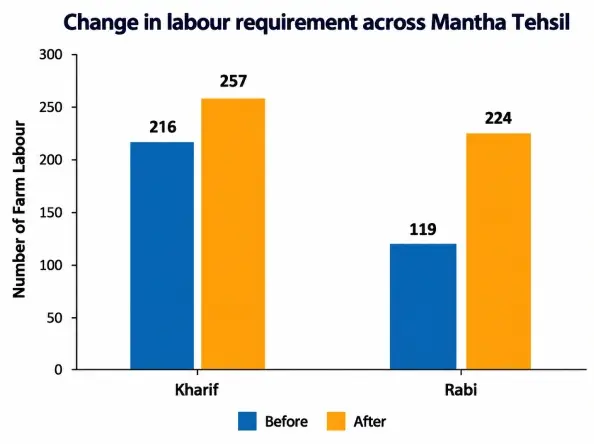
Labour requirement during the Rabi (winter) season increased by 88%, from 119 to 224 farm labourers. Kharif season labour grew by 19%. With work available year-round, farmers no longer need to migrate to cities for off-season employment.
Land Under Cultivation: Up 58% in Rabi
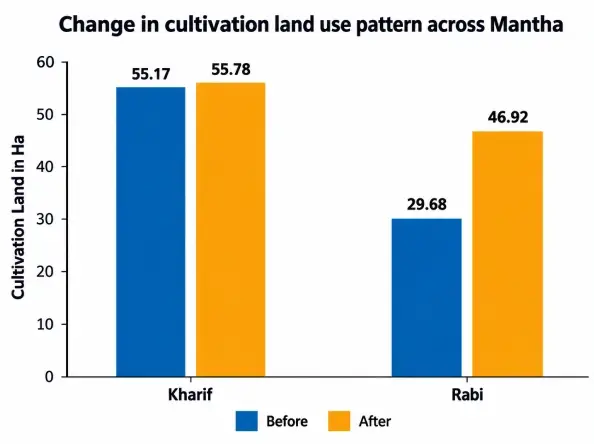
Rabi season cultivated area increased from 29.68 hectares to 46.92 hectares, a 58% increase. Kharif season land use held steady with a 1% increase. The jump in Rabi cultivation was possible because farmers now had enough groundwater to plant a second crop in the dry season.
Social Return on Investment
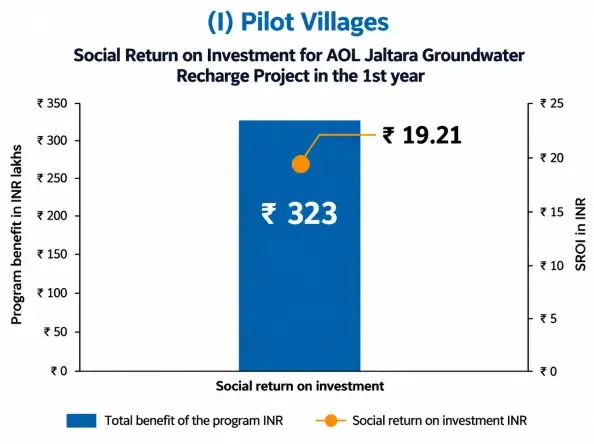
The total programme benefit for the pilot villages was Rs 322.73 lakhs, with a Social Return on Investment of Rs 19.21 per rupee invested. For the forecast villages at scale, the projected total benefit was Rs 1,359.60 lakhs with an SROI of Rs 30.81 per rupee.
| Benefit Category | Pilot Villages (Rs Lakhs) | Forecast Villages (Rs Lakhs) |
|---|---|---|
| Farm profits | 90.13 | 608.00 |
| Benefit from livestock | 0.55 | 3.00 |
| Increased labour requirement | 10.72 | 116.00 |
| Avoided crop loss (waterlogging) | 4.88 | 16.19 |
| Avoided water tanker cost | 0.21 | 3.70 |
| Avoided pollution (fertilizer) | 3.98 | 18.64 |
| Water recharge | 217.33 | 609.41 |
| Carbon savings (forecasted) | 0.08 | 1.79 |
| Total programme benefits | 322.73 | 1,359.60 |
| SROI (per INR invested) | Rs 19.21 | Rs 30.81 |
Source: GIST Impact, "Stakeholder Impact Assessment for The Art of Living JalTara Groundwater Recharge Project," December 2022. The SROI cannot be 100% attributed to JalTara alone, as multiple ecological and anthropogenic factors may contribute.
Government Validation: Jalyukt Shivar Abhiyan 2.0
The success of JalTara in Jalna prompted the Government of Maharashtra to adopt a scaled-up version of the approach. On 26 November 2023, an MoU was signed between The Art of Living Social Projects and the Department of Soil and Water Conservation, Government of Maharashtra. Endorsed by Gurudev Sri Sri Ravi Shankar, this three-year initiative targets water conservation across 24 districts and 87 talukas of Maharashtra.
While JalTara works at the individual farm level with recharge pits, Jalyukt Shivar Abhiyan 2.0 targets the network of nalas (drainage channels) that carry monsoon water across the state. Over decades, these channels had filled with silt, reducing their carrying capacity and causing floods during rains while leaving fields dry the rest of the year.
Results to date
In just 75 days (March to mid-June 2024), The Art of Living teams excavated and desilted over 23 lakh cubic metres of water storage capacity, equivalent to 2.3 trillion litres.
The work has been implemented across 10 districts: Nagpur, Wardha, Amravati, Akola, Buldhana, Beed, Latur, Solapur, Ahmednagar, and Nandurbar.
In Mauda, Nagpur alone, over 200 kilometres of nalas were cleared, benefitting more than 2,25,000 villagers.
The project has also revived ancient nalas and canals buried under silt for over 70 years, now channeling water to agricultural fields as they were originally meant to.
Voice From the Field
One Pit Per Acre. One Season to See the Difference.
Your donation builds the recharge structures that replenish India's groundwater, double farmer incomes, and end the cycle of drought and migration.
All donations are eligible for tax exemption under Section 80G of the Income Tax Act.